Showing posts with label Philosophy. Show all posts

Thursday, December 18, 2014

Honoring the Sun with Movement, Mantra and Breath


As we approach the Winter Solstice, we in the Northern Hemisphere are experiencing a time of increasing darkness. On December 21st, the Longest Night, the diminishing daylight reaches its peak, and the sun begins its gradual ascent back to the balance of Spring Equinox, returning to fullness on the Longest Day, Summer Solstice.

The practice of Surya Namaskar, or Salutation to the Sun, offers us a way to honor the sun's journey, to reflect on the many gifts that we receive from the sun, and to welcome its return to fullness.  It is a meditation-in-motion that draws upon the qualities of our own divine light, connecting with the radiance of our true Self.  This is a practice which is both contemplative and physical, toning and strengthening our muscles, nourishing our internal organs, awakening the energy body with prana, and cultivating a sense of devotion and gratitude.

Our practice begins by tuning in to the breath. Just as the sun moves from emptiness to fullness as it circles from Solstice to Solstice, and rises and sets from day into night, so moves our breath--filling, emptying, filling again in this continual, life-sustaining rhythm. If we add a short retention at the top of the inhale and at the bottom of the exhale, we mirror the pause of the sun at the Winter and Summer Solstices (the word "solstice" comes from the Latin sol, meaning "sun," and stitium, which means "to pause or stop." The sun appears to linger for a while at the peak of long, light-filled days in Summer, or in the very short, dark days of Winter, before we can perceive a slow shift in the length of the days). So as we turn our attention to our breath, inviting in a pause in fullness and in emptiness, we still the mind and calm the nervous system, while honoring the rhythm of life.

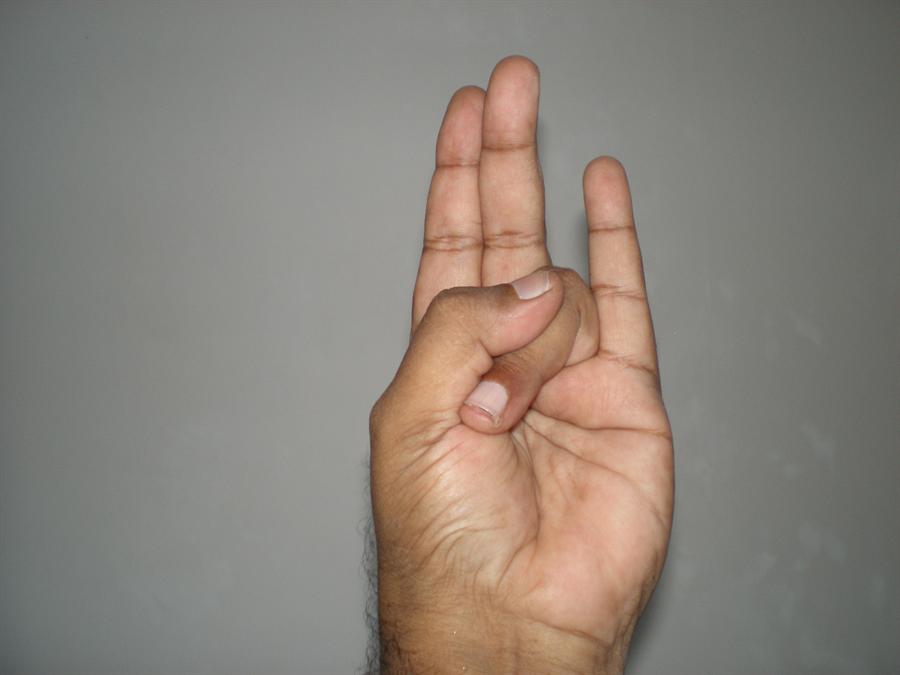
While taking a few minutes to breathe deeply,  try bringing the hands into Surya Mudra (the mudra of the sun), which increases the fire (Agni) element in the body. This mudra creates warmth, preparing us mentally, physically and energetically for Surya Namaskar.


The twelve sun mantras
Every year the sun passes through twelve different phases,  known in Western astrology as the Zodiac,, and 'rashis' in Hindu astrology.  Each rashi has a specific attribute or mood, and in each of these twelve moods the sun is given a different name. These twelve names comprise the twelve Vedic sun mantras, which are to be mentally repeated in their respective order in conjunction with the twelve movements of surya namaskara.

These sun mantras are not merely names of the sun, but every sound syllable contained in them is the vehicle of a basic, eternal energy (shakti) represented by the sun itself. By repetition and concentration on these mantras, one's entire mental and subtle body will be energized.

Although these mantras do not require intellectual understanding, translation of their meaning is given below for those who wish to use the mantras as a form of attunement with the source of spiritual illumination symbolized by the sun. 

Here is the sequence of twelve postures of Surya Namaskar, with the associated mantras:

1. Om Mitraya Namaha
(Salutations to the friend of all)
Pranamasana: standing with palms joined at the heart center
This first position embodies the attitude of reverence to the source of all life as we know it. The sun is regarded as the universal friend, endlessly giving light, heat and energy to support this and all the other planets. In the scriptures, Mitra is described as calling us to activity, sustaining earth and sky, and beholding all creatures without discrimination, just as the early morning sun signals the beginning of the day's activities, and sheds its light on all life.

2. Om Ravaye Namaha
(Salutations to the shining one)
Hasta Uttanasana: hands raised to the sky, slightly bending backwards (if comfortable)
Ravaye means one who shines and offers divine blessings upon all life. In this position, we are stretching our whole being upwards, towards the source of light, to receive these blessings.

3. Om Suryqya Namaha
Uttanasana: Standing forward bend, hands to the floor
(Salutations to the one who induces activity)
Here the sun is in a very dynamic aspect as the deity, Surya. In ancient vedic mythology Surya was worshipped as the Lord of the Heavens, pictured crossing the sky in his fiery chariot, drawn by seven horses.  The seven horses actually represent the seven rays or emanations of the supreme consciousness, which manifest as the seven planes of existence, bhu (earthly, material), bhuvar (intermediate, astral), suwar (subtle, heavenly), mahar (the abode of the devas), janah (the abode of divine souls who have transcended ego), tapah (the abode of enlightened siddhas) and satyam (the ultimate truth of reality). Surya symbolizes the supreme consciousness itself, in control of all these different planes of manifestation. 

4. Om Bhanave Namaha
(Salutations to the one who illumines)
Ashwa Sanchalanasana: Low lunge, back knee rests on mat. fingertips to the floor
The sun is the physical representation of the guru or teacher, who removes the darkness of our delusions, just as the darkness of the night is removed with every dawn. In this position, we turn our face towards this illumination and pray for an end to the dark night of ignorance.

5. Om Khagaya Namaha
(Salutations to the one who moves through the sky)
Plank pose: shoulders over wrists, arms and legs straight, body in one line.
It is the sun's daily movement through the sky which is the basis of our measurement of time, from the earliest use of a sun dial to the sophisticated devices used today. In this posture, we offer obeisance to the one by whom time is measured, and pray for progress in life.

6. Om Pushne Namaha
(Salutations to the giver of strength and nourishment )
Ashtanga Namaskar: knees, chest, chin, hands and balls of feet touch the floor, buttocks raised.
The sun is the source of all strength, nourishing us with energy, light and life. We offer respects in ashtanga namaskara by touching all the eight corners of our body to the ground. In essence we are offering our whole being in the hope that the sun may bestow mental, physical and spiritual strength and nourishment upon us.

7. Om Hiranya Garbhaya Namaha
(Salutations to the golden cosmic self)
Bujangasana: Cobra pose--palms down, under shoulders, chest and torso raised, with elbows bent.
Hiranya Garbha is also known as the golden egg, resplendent as the sun, in which Brahma was born as the manifestation of Self-existence. Hiranya Garbha is the seed of causality, thus the whole universe is contained within Hiranya Garbha in the potential state prior to manifestation. In the same way, all life is potential in the sun, which represents the great cosmic principle. We offer respects to the sun in this position, praying for the awakening of creativity.

8. Om Marichaye Namaha
(Salutations to the rays of the sun)
Adho Mukha Svanasana: Downward-facing dog. Inverted V, hips high, hands and feet flat.
Maricha is one of Brahma's sons, just as the rays of light are produced from the sun, but his name also means mirage. For our whole life, we seek after a true meaning or purpose, like the thirsty man seeks after water in a desert, but is fooled by mirages dancing on the horizon produced by the sun's rays. In this position, we pray for true illumination and discrimination in order to be able to distinguish between the real and the unreal.

9. Om Adityaya Namaha
(Salutations to the son of Aditi)
Ashwa Sanchalanasana: Low lunge (whichever leg stepped back now comes forward).
Aditi is one of the many names given to the cosmic mother, Mahashakti. She is the mother of all the gods, boundless and inexhaustible, the creative power from which all divisions of power proceed. The sun is one of her children, or manifestations. In this position, we salute Aditi, the infinite cosmic mother.

10. Om Savitre Namaha
(Salutations to the stimulating power of the sun)
Uttanasana: Standing forward bend, hands to the floor
Savitre is known as the stimulator, the arouser, and is often associated with Surya.  Savitre is said to represent the sun before rising, stimulating and arousing us into waking activity, and Surya is said to represent the sun after sunrise, when activity begins. Therefore, in this position, we salute Savitre to obtain the vivifying power of the sun.

11. Om Arkaya Namaha
(Salutations to the one who is fit to be praised)
Hasta Uttanasana: hands raised to the sky, slightly bending backwards 
Arka means energy. The sun is the source of most of the energy in the world we know. In this position, we are offering respects to this source of life and energy.

12. Om Bhaskaraya Namaha
(Salutations to the one who leads to enlightenment)
Pranamasana: standing with palms joined at the heart center
In this final salutation we offer respects to the sun as a symbol of the great revealer of all transcendental and spiritual truths. It lights up the pathway leading to our ultimate goal of liberation. In this position, we pray that this pathway may be revealed to us.

Finally, we can end our practice in Savasana, noticing the enlivening effects of Surya Namaskar. 


Note: The above interpretation of the sun mantras is referenced from the book “Surya Namaskara” from the Bihar School of Yoga.

Listen and practice along with this 16 minute recording:


Tuesday, September 27, 2011

The Transformative Power of Shiva


Hello Dear Yogis, and Happy Autumn!

At this time of year, when the growing season comes to a close and the earth prepares for dormancy, I am reminded of Shiva, the Hindu deity that embodies transformation and change. In the Hindu Trinity that consists of Brahma (the creative force that brings all forms into being), and Vishnu (the preserver, who sustains and balances all life),  Shiva is the destroyer, and is responsible for the necessary dissolution of all life forms, creating space for new birth.

Shiva is the power of transformation and purification that lives in each of us. Shiva clears away whatever is old and no longer serves us. Shiva calls us to let go of illusion, to dissolve the egoic mind that keeps us stuck in our sense of separateness, and lovingly destroys all that keeps us from knowing our inherent divinity.

And, Shiva is also that state of Grace, that pure consciousness that is present when all illusion falls away. So, Shiva is both a process of transformation and the end result of that process.

Iconically, Shiva is represented in myriad ways. One common image is the Nataraj, or dancer, who dances wildly in a ring of fire, turning everything to dust. This fire dance symbolizes the circle of samasara, the earthly round of creation and destruction through which all beings pass.


In addition to being the destroyer, Shiva is often depicted as a contemplative, who after witnessing the suffering of earthly beings, sought to find a way to peace and freedom.  This search led him into deep meditation, leading to the discovery of  the yoga asanas and other practices, which he then taught to his wife, Parvati.


Shiva is also worshipped in the form of the lingam, a stone phallus. Elaborate pujas (devotional rituals) are performed in which the lingam is bathed in milk and honey, decorated with garlands of flowers, and smeared with fragrant sandalwood paste. The Shiva lingam represents the vast potential and possibility that lies within each and every one of us. So, although Shiva is responsible for destroying life, He is also recognized as an essential creative power.


One can explore in great depth the myth and symbolism behind any of the gods and goddesses in the Hindu pantheon. For some, the anthropomorphic images and stories can help them connect to the energy that lies behind the forms. However, it is not necessary for one to believe in a literal deity in order to access their power. We only need to look at life around us to receive their essence.

Autumn is a time when we can feel and see the presence of Shivaas we witness the falling away of what is finished. In every leaf that falls, Shiva is present. In every withering vine, Shiva is alive.

Shiva is present when we say goodbye to loved ones who have come to the end of their life in this body and must pass on.

Whenever we must let go of an old habit or some way of being that no longer serves us, Shiva is alive in us, doing his dance of transformation, clearing us out and creating an opening for the new to come streaming in.

And, Shiva lives in us as we practice yoga and meditation, as we seek to unleash our own innate transformative power, through this path to peace.

I offer you this chant that I often sing as an invocation to begin our yoga classes:

Om Namah Shivaya Gurave
Saccidananda Murtaye
Nischprapanchaya Shantaya
Niralambaya Tejase

I bow to the goodness within myself, known as Lord Shiva, who is the true teacher.
This essence inside takes the form of truth, consciousness, and bliss
Always present and full of peace,
this essence inside is completely free,
and sparkles with a divine luster.


May our yoga practice illuminate the divine luster within us, and together may we bring light to the world. 


Wednesday, September 21, 2011

The Meaning of 108


If you saw the announcements for the 108 sun salutations event that happened in Ithaca this past weekend, you may wonder what’s so special about the number 108. Or, if you use a mala, or set of mantra counting beads, there are generally 108 beads (or some fraction of that number). Why are there 108 beads on a mala?

If you really delve deeply into the answer, it can make your head spin, as some of the explanations are quite complex. I offer below just a few of the associations with the number 108, both from the yoga tradition and from other spiritual teachings as well.

Note: I can’t vouch for the accuracy of all the statements below, as it would have taken hours of research.  These have been gathered from a variety of sources, on the web and from written materials. Some of these tidbits of information may be useful to you, while some of it might seem like myth or superstition. I invite you to see what resonates with you, taking what you like and leaving the rest.

9 times 12: Both of these numbers have been said to have spiritual significance in many traditions. 9 times 12 is 108. Also, 1 plus 8 equals 9. That 9 times 12 equals 108.
Powers of 1, 2, and 3 in math: 1 to 1st power=1; 2 to 2nd power=4 (2x2); 3 to 3rd power=27 (3x3x3). 1x4x27=108
Harshad number: 108 is a Harshad number, which is an integer divisible by the sum of its digits (Harshad is from Sanskrit, and means "great joy")
Desires: There are said to be 108 earthly desires in mortals.
Lies: There are said to be 108 lies that humans tell.
Delusions: There are said to be 108 human delusions or forms of ignorance.
Heart Chakra: The chakras are the intersections of energy lines, and there are said to be a total of 108 energy lines converging to form the heart chakra.
Marmas: Marmas or marmasthanas are like energy intersections called chakras, except have fewer energy lines converging to form them. There are said to be 108 marmas in the subtle body.
Sanskrit alphabet: There are 54 letters in the Sanskrit alphabet. Each has masculine and feminine, shiva and shakti. 54 times 2 is 108.
Pranayama: If one is able to be so calm in meditation as to have only 108 breaths in a day, enlightenment will come.
Upanishads: Some say there are 108 Upanishads, the vedic texts of the ancient India.
Sri Yantra: On the Sri Yantra (a sacred geometric figure) there are marmas where three lines intersect, and there are 54 such intersections. Each intersections has masculine and feminine, shiva and shakti qualities. 54 times 2 equals 108. Thus, there are 108 points that define the Sri Yantra as well as the human body.
Pentagon: The angle formed by two adjacent lines in a pentagon equals 108 degrees.
Time: Some say there are 108 feelings, with 36 related to the past, 36 related to the present, and 36 related to the future.
8 extra beads: In doing a practice of counting the number of repetitions of the mala, 100 are counted as completed. The remaining are said to cover errors or omissions. The 8 are also said to be an offering to God and Guru.
Astrology: There are 12 constellations, and 9 arc segments called namshas or chandrakalas. 9 times 12 equals 108. Chandra is moon, and kalas are the divisions within a whole.
River Ganga: The sacred River Ganga spans a longitude of 12 degrees (79 to 91), and a latitude of 9 degrees (22 to 31). 12 times 9 equals 108.
Planets and Houses: In astrology, there are 12 houses and 9 planets. 12 times 9 equals 108.
Goddess names: There are said to be 108 Indian goddess names.
Gopis of Krishna: In the Krishna tradition, there were said to be 108 gopis or maid servants of Krishna.
1, 0, and 8: Some say that 1 stands for God or higher Truth, 0 stands for emptiness or completeness in spiritual practice, and 8 stands for infinity or eternity.
Sun and Earth: The diameter of the Sun is 108 times the diameter of the Earth. The distance from the Sun to the Earth is 108 times the diameter of the Sun.
Moon and Earth: The average distance of the Moon from the Earth is 108 times the diameter of the Moon.
Silver and the moon: In astrology, the metal silver is said to represent the moon. The atomic weight of silver is 108.
Numerical scale: The 1 of 108, and the 8 of 108, when added together equals 9, which is the number of the numerical scale, i.e. 1, 2, 3 ... 10, etc., where 0 is not a number.
Meditations: Some say there are 108 styles of meditation.
Breath: Tantra estimates the average number of breaths per day at 21,600, of which 10,800 are solar energy, and 10,800 are lunar energy. Multiplying 108 by 100 is 10,800. Multiplying 2 x 10,800 equals 21,600.
Paths to God: Some suggest that there are 108 paths to God.
Smaller divisions: The number 108 is divided, such as in half, third, quarter, or twelfth, so that some malas have 54, 36, 27, or 9 beads.
Hinduism: 108 is said to refer to the number of Hindu deities. Some say that each of the deities has 108 names.
Islam: The number 108 is used in Islam to refer to God.
Jain: In the Jain religion, 108 are the combined virtues of five categories of holy ones, including 12, 8, 36, 25, and 27 virtues respectively.
Sikh: The Sikh tradition has a mala of 108 knots tied in a string of wool, rather than beads.
Buddhism: Some Buddhists carve 108 small Buddhas on a walnut for good luck. Some ring a bell 108 times to celebrate a new year. There are said to be 108 virtues to cultivate and 108 defilements to avoid.
Chinese: The Chinese Buddhists and Taoists use a 108 bead mala, which is called su-chu, and has three dividing beads, so the mala is divided into three parts of 36 each. Chinese astrology says that there are 108 sacred stars.
Stages of the soul: Said that Atman, the human soul or center goes through 108 stages on the journey.
Dance: There are 108 forms of dance in the Indian traditions.
Praiseworthy souls: There are 108 qualities of praiseworthy souls.
First man in space: The first manned space flight lasted 108 minutes, and was on April 12, 1961 by Yuri Gagarin, a Soviet cosmonaut.
Names for Shiva: 108 is the number of names for Shiva (an important Hindu god)
Names for Buddha: 108 is the number of names for Buddha
Man: 108 is the Chinese number representing "man"
Tibetan Mala: 108 is the number of beads on a Tibetan "mala"
Judaism: 108 is six times the number "18", which is a Jewish good luck number
Sun Salutations: 108 is twelve times the number 9, which is the number of vinyasas (movements linked to breath) in a Sun Salutation.
Tantra: According to the Tantric heritage, there are 108 pilgrimage centers (pîtha) that are dedicated to the feminine (lunar) principle, or Shakti.

And, if I haven’t lost you by now, and you really like numbers, here’s more:

The number 108 is connected with 18, which, in Hindu symbolism, is said to represent completeness or wholeness. This number is prominent in the Mahâbhârata epicwhich consists of 18 books, just as the Bhagavad-Gîtâ (embedded in the epic) consists of 18 chapters. The Bharata war was waged for 18 days, and the armies (akshauhinî) on the opposing sides numbered 18 as well. An akshauhinî consists of 21,870 chariots, 21,870 elephants, 65,610 horses, and 109,350 footsoldiers, which makes a total of 218,700 units. The total of the digits of each number adds up to 18! The epic has many more instances of this kind relating to the number 18, and it is also found in other Indian works. The Mahâbhârata (12.267.28) itself provides a key to this symbolic number as follows:

The connection between 18 and 108 can be found also in an important microcosmic cycle, namely the 21,600 daily breaths we take. According to Tantra, 10,800 breaths are lunar, 10,800 breaths are solar. They alternate in us in the form of the alternating nasal cycle, which medicine has confirmed, so that the body has its microcosmic reflection of the macrocosmic eclipses. The microcosmic/macrocosmic parallelism was of the utmost significance to the Indian sages. They saw it as demonstrating the flawless harmony (rita) at work in the cosmos.

Now, 21,600 = 18 x 1200 or 108 x 200. 21,600 yields other important numerical derivations:
21,600 : 60 = 360 (the ideal Vedic year)
21,600 : 800 = 27 (number of lunar houses in Vedic astrology)
21,600 : 108 = 200 (number of arcseconds defining a navâmsha in Vedic astrology)
Looking at a larger cosmic cycle—the yugas (or world ages)—we find that each is calculated as multiples of 21,600.
krita-yuga —1,728,000 solar years = 21,600 x 80
tretâ-yuga —1,296,000 solar years = 21,600 x 60
dvâpara-yuga —864,000 solar years = 21,600 x 40
kali-yuga — 432,000 solar years = 21,600 x 20
The sum total of these four world ages makes:
kalpa — 4,320,000 solar years = 21,600 x 200 or 108 x 40,000 or 18 x 240,000

Thus the number 18 is fundamental to Indian psychocosmology.

So, dear yogis, that should give you plenty to digest. If it's not already part of your practice, you may want to explore  reciting a mantra or prayer 108 times daily with a mala. Or,  you may want to try 108 repetitions of a particular pranayama (breath control technique) and see what you notice. May you enjoy your own inquiry into the power of 108! 

.

Sunday, September 4, 2011

Jai Ganesha!


Hello Dear Yogis,

Labor Day weekend marks the beginning of the fall season. Although the actual autumn equinox is still a few weeks away, culturally this is the end of summer. New schedules and routines begin as students and teachers go back to school, and we gear up for new projects and activities.

It is customary in the Hindu/yogic tradition to invoke Ganesha, the Lord of beginnings, of success, and the remover of obstacles, at the start of any new endeavor. He is also honored at the beginning of rituals and ceremonies, and kirtan (Hindu call and response devotional chanting) typically begins with a chant to Ganesha.

Ganesha is one of the most beloved Hindu gods. He is also known by the name Ganapati, as well as many other epithets. He is the child of Shiva and Parvati (who were the very first yogis). He has an elephant head with huge ears, and a pot-bellied body of a human. He is often depicted riding on a mouse. Volumes have been written about the rich symbolism of the images, and there are many colorful stories about how he came to have an elephant’s head. If you have an interest in delving into the mythology, here are a few sites you can visit:

About.com

Ganesha Home Page

Encyclopedia Mythica


Ganesha is also associated with the Muladhara Chakra, the energy center at the base of the spine. It is said that he guards the gate of the Kundalini (spiritual energy) that lies coiled there.

Here is a mantra that is typically chanted to call upon the power of Ganesha (Ganapati) at the beginning of a new undertaking:

OM GAM GANAPATAYE NAMAHA

OM: The primordial sound of the universe.
GAM: the bija, or “seed” mantra of Ganesha (pronounced somewhat like the English word “gum”). Bijas hold the vibrational/energetic power of particular deities.
GANAPATAYE: “unto Ganapati”
NAMAHA: “I bow to; I honor; I offer myself to”

So, this mantra can be translated as:

I offer myself to Ganesha, the Lord of beginnings and the remover of obstacles.


Mantras can be sung, spoken aloud, or repeated silently to oneself. It is helpful to use a mala (string of prayer beads) to count repetitions and help keep awareness on the mantra.

I want to emphasize that one does not need to believe in a literal deity in order to sing and benefit from mantra practice. There are many ways we can relate to the sacred Names. Some people find that the mythology, stories, and images associated with the various gods and goddesses help them connect with the Divine Energy by providing concrete forms. Others can better relate to the deities as representations of qualities or energies that are within us. So, as we chant to Ganesha, we are invoking the ability to embrace the new, and to clear away any stale energy, negative thinking, or unhealthy habits that have become hindrances to becoming our best self.

There are many recordings of chants to Ganesha. Some of my favorites are by MC Yogi, who creatively blends hip-hop rhythms with traditional Sanskrit chants, and cleverly weaves in the symbolism and mythology into a rap song with a danceable beat. Check out his songs “Elephant Power “ and “Ganesh is Fresh” (available on iTunes) if you want to learn more about and celebrate Ganesha in a fun way.

May your new beginnings be auspicious and your path be clear as you move in the direction of your dreams. Jai Ganesha!


Every Possibility

Amid the thousand fears that flesh is heir to, there is also peace. 
When I look beneath the boulder of anxiety, 
the mountain of my doubt, 
I find the shining silence, 
and rest until my being vibrates with only one note.
This is what I bring into my day, 
he wordless sound of all creation, 
the empty space of every possibility 
poised and ready to take shape.


by Danna Faulds, from From Root to Bloom, Peaceable Kingdom Books © 2006

Wednesday, August 10, 2011

The 5 Prana Vayus

Hello Dear Yogis,

The science and philosophy of yoga offers us many fascinating models with which can we can view the human organism. In past posts I’ve written about the koshas (sheaths, or layers of being) and the chakra system (energy vortexes) that comprise both the physical and subtle bodies. Today I’ll share about the 5 prana vayus, or “winds” that are responsible for the motion of prana, or life energy.

Vayu means “wind, air or unseen forces.” Vayu is also the wind-god, who in the Vedic system is the Master of Life,  and the inspirer of breath and the dynamic energy of prana.
.
Prana is continually moving through us and the universe in all directions. Yoga practice allows us to tune into and harness this flow so that we can increase our vitality and power. The prana vayus, also simply referred to as the vayus, are 5 vital currents:

Apana Vayu is the downward flow of energy, associated with elimination, the release of bodily fluids, and the exhale of the breath. In the world, we see Apana manifest through the force of gravity, and through the roots of plants. It is associated with the element of earth.

Prana Vayu* is the upward flow of energy, associated with the inhale, the receptive sense organs, and the element of air. We see prana vayu manifest in photosynthesis, as leaves reach up to draw in the light of the sun.

Samana Vayu is the inward flow of energy, which moves in an inward-turning spiral.  It is associated with the digestion and assimilation of nutrients, and the element of fire. Anything that spins toward a center point is a manifestation of samana, also known as centripetal force. The practice of meditation, in which we turn inward toward our center, is one way in which we engage in the flow of samana vayu.

Udana Vayu is outward movement, associated with speech, sound, space/ether, and the limbs of the body.  Udana moves in an outward turning spiral, spinning away from center; it is centrifugal force. When our vital energy manifests through our full self-expression, udana vayu is present.

Vyana Vayu is the energy of expansion, moving simultaneously in all directions. It is all-encompassing. It is the interwoven matrix of life, the web of the connection, what is known in Eastern mythology as “Indra’s net.” The energy of vyana pervades the entire body and is the bridge that leads from the physical to the ethereal realms. It is connected to the element of water.

These five forces are not discrete or firmly delineated; they all interweave and interrelate. Naming them and describing them as separate phenomena simply help us to understand their essence and give us a framework through which we can view the unfolding of all life.

On the mat, we can bring our attention to these five winds of life energy as we move  through our asana flow.  We can connect to apana vayu as we stabilize and ground through the feet or the sitting bones, and harness the force of gravity to keep us strongly rooted and connected to the earth. Prana vayu helps us brighten the pose and create upward lift, length, and extension. Together, apana and prana are two opposing (yet complimentary) forces that make the pose come together. First we stabilize, then we expand.

For example, in warrior 1, we begin by grounding through the 3 points of the feet, engaging strong thighs and drawing the tailbone downward as the front knee bends. We keep engaging this downward-flowing energy while at the same time lengthening upward through the spine, pressing the crown of the head toward the sky. The upward lift of the arms invites prana to flow out through the fingertips. The simultaneous flow of apana and prana creates the pose and makes it come alive.  

Samana in postures invites us to wiggle and move, with sense of inward exploration. Kripalu yoga emphasizes inquiry as we deepen into a pose, turning inward with our awareness.

Once we are stable and aligned in our joints, muscles and bones, we can play with udana, extending outward both physically and energetically.  Udana invites us to come into full expression of the pose, reaching out through limbs and crown, and lengthening  the spine. We can also embody the pose as self-expression, sending our inner radiance out from our center.

When we rest in savasana, we allow space for the life force we’ve generated through asana practice to permeate the whole body, though every cell, organ, muscle and bone. It flows through us in all directions. As we let ourselves dissolve into emptiness, we might be able to glimpse the expansive energy of vyana. We drop into boundarylessness, and at the same time, awareness of connection with All That Is.

May the awareness of these vital currents, or winds of energy, enhance and enrich your practice and your life.


*note: the word prana refers to the life force in general, and in the context of the 5 winds, also means upward flow of energy.


INSPIRATIONAL WORDS

INSPIRATIONAL WORDS
Poetry, readings & words of wisdom from modern and ancient sources