Showing posts with label Koshas. Show all posts

Tuesday, July 19, 2011

Authenticity


Henry David Thoreau said, “We are constantly invited to be who we are.”

I think that’s a beautiful description of Kripalu yoga, which is an inquiry into who we are, through movement, breath, and awareness. When we practice on the mat, we are engaged in a process of discovery as to who we are in this moment, and then the next, and the next. The same applies to our practice off the mat, as we work to live ethically, mindfully, heartfully.

The yogic view sees the self as being many-layered, having a physical body, a subtle or energy body (which includes the thoughts, emotions, intuitive wisdom, and the circulation of life force) and a causal body (expansive and blissful).  In this exploration of our many-layered selves (see my post on the 5 koshas for a more in-depth discussion), we have the opportunity to live our lives from a more authentic place.

One of my teachers at Kripalu, Dinabandhu Sarley, says that when what we think, what we feel, what we say, and what we do are all in alignment, something transformational happens—it’s called authenticity.  Just as we practice physical alignment on the mat to allow prana (life energy) to flow freely through us, practicing alignment in all aspects of our lives allows us to be a clear, open conduit for prana to flow through us and into the world through our actions.  Our ability to be powerful in our lives is contingent upon our ability to bring those four areas into alignment.

When any one or more of those areas—thought, feeling, speech, action-- are out of sync with the rest, the conduit becomes blocked—it’s like a garden hose that gets kinked in 4 places.  We can’t be truly at peace or fully alive if we are lying to ourselves, not being truthful with others, or otherwise “in the closet” about who we truly are. Our life force becomes impeded and depleted.

Ultimately, a yogi’s life becomes focused on the question: “How do I become free, whole and alive?” Yoga gives us tools with which we can practice living in alignment, such as the yamas and niyamas, which offer ethical guidelines for our interpersonal relationships and personal commitments. In short, they call us to speak the truth, honor one another, and live with intention and direction.

Practicing authenticity takes courage, as well as much unlearning of unskillful ways of being that may have become deeply ingrained.  Being authentic does not guarantee that we will be liked. In fact, we are likely to ruffle some feathers and perhaps alienate some people who are not ready to receive the rigorous honesty that it entails. When we tell the truth, in the deepest sense, things begin to re-arrange in our world. Things, people, and activities that don’t serve us clear out of the way, making room in our lives for What Really Matters.

Ultimately, authenticity is about living from Love. As yogis, may we support one another in this discovery of the truth of who we are.

Everything will line up perfectly when knowing and living the truth becomes more important than looking good. ~Alan Cohen

Seek out that particular mental attribute which makes you feel most deeply and vitally alive, along with which comes the inner voice which says, ‘This is the real me,’ and when you have found that attitude, follow it. ~William James



Tuesday, May 31, 2011

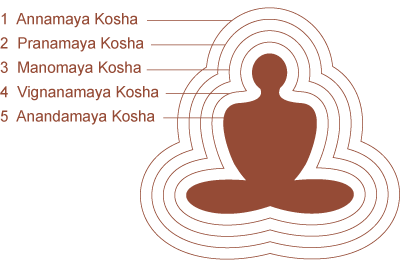
The 5 Koshas

The science and spirituality of yoga invites us to explore many different ways of looking at the self. There are several useful conceptual models that can help us understand the multidimensional beings that we are. In addition to using western anatomy to understand and condition our physical being, yoga philosophy offer us maps to explore the terrain of the subtle body, or energy anatomy.

One of these maps, called the koshas,  is an ancient system made up of 5 layers, or sheaths, that comprise our physical, emotional and spiritual being.  These layers progress from the most dense to the ethereal, yet they are not completely separate, discrete entities—they are interdependent and intertwined. In brief, they are:

Annamaya kosha: the physical body, or “food” sheath. This is the most dense and obvious layer—our bones, muscles, organs, and outer appearance.

Pranamaya kosha: the breath sheath. This is the vital life force that moves through the body. The breath is the primary vehicle by which we can increase the flow of this life force through the energy channels (nadis) of the subtle body.

Manamaya kosha: the mental sheath. This layer is made up of our continually changing thoughts and feelings, the vacillations of mind and waves of emotion. This kosha governs the rational, linear, and sequential thought processes. It is sometimes referred to as the “lower” mind (not because it is bad, but because it does not operate with expansive awareness).

Vijnanamaya kosha: Wisdom mind.  Also considered the “higher mind,” this kosha brings us intuitive knowing and higher levels of consciousness. It allows us to develop “witness consciousness”, the ability to observe the comings and goings of mental and emotional states without judging them or being identified with them. It allows us spaciousness of mind and heart as we move through life’s joys and challenges. It is the bridge between the egoic self and the higher Self.

Anandamaya kosha: the bliss sheath. When we have moments of deep peace, awakening to Presence with a sense of connectedness to All That Is, we are dwelling in this kosha. We get a glimpse of our limitless, spacious self, our true magnificence.

Awareness of these layers of being is not a linear progression. Our consciousness moves freely between them, and each one influences and informs the others. For example, breath control practices increase the flow of prana, or life force (pranamaya kosha), which can be felt in the body as energy and physical sensation.  Our heart rate and blood pressure are affected (annamaya kosha), while the thoughts and emotions come into stillness (manomaya kosha).

It is interesting to note that each of the koshas has the word maya in it, which means “illusion,” or “veil.”  Even the bliss sheath is a thin layer of separation from Pure Consciousness. All of the layers are manifestations of form, but beneath them all lies the undifferentiated, primordial essence of Brahman.


If the koshas are seen as coverings that veil the light of our true self, does this mean that the intention of our life’s journey is to transcend the first four to finally arrive at bliss? Kripalu teacher and writer Danny Arguetty suggests that the goal is to awaken to the presence of ananda (bliss) in each one of these layers.  “In lieu of a systematic journey wherein the mission is to travel through each kosha in turn to find only joy in the last, we engage in an ongoing, dynamic dance that unearths the ecstasy embedded in each sheath.”

The various practices of yoga support us in the exploration of each of these layers. Our asana practice  supports inquiry of the physical sheath.  Breathing practices (pranayama) aid in the exploration of our energy body. Concentration and meditation support clarity and balance on the emotional and mental layer. All of these practices help cultivate the witness, clearer seeing and greater access to our intuitive wisdom. When we tone our layers in this way, we create the conditions for us to open to and experience moments of bliss, the grace of seeing our true expansive nature.


INSPIRATIONAL WORDS

INSPIRATIONAL WORDS
Poetry, readings & words of wisdom from modern and ancient sources