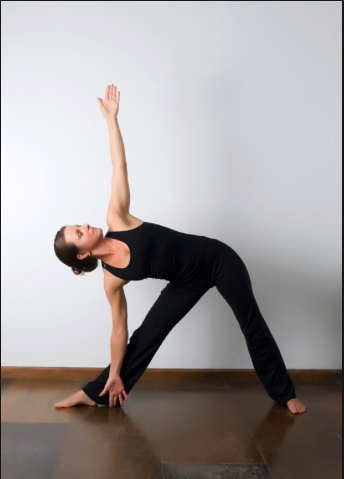
Triangle pose is known as Trikonasana
in Sanskrit—tri meaning three and kona meaning corner. Triangle
is a therapeutic pose that provides many benefits including strengthening of
the core and legs.
Starting from standing mountain pose,
turn sideways on your mat and come into 5-pointed star pose. Spread your feet
apart approximately the length of one of your legs--this usually works out to
be about three or four feet apart. Look down at your feet, your left big toe
should line up exactly with your right big toe to ensure your hips are in
perfect alignment.
Turn your right toe out 90 degrees
and turn your left foot in about 45 degrees. Make sure you have a full external
rotation of the right thigh so your right knee is aligned directly over the
right foot. This means the rotation of your right leg comes from the hip joint,
not the ankle joint. Lift your arms up and extend them out directly from your
shoulders, arms parallel to the floor and palms facing the floor. Inhale deeply
and drop your shoulders away from your ears.
Extend your torso to the right
directly over the right leg. You’re your torso in the same plane as your hips
and legs (imagine your body is between two panes of glass). Bend from the hip,
not the waist. Keep activating and pressing down through the outer left foot to
secure your pose and lengthen your body. Imagine that the right side of your
body is just as long as the left—don’t crunch up the right side to go deeper.
Slide the back of the right hand down the inner right shin until you feel
resistance, then stop and hold. Do not hold on to your ankle, doing that
deactivates your abdominal muscles, causing you to sink your right shoulder
into your right ear.
You want to maintain a feeling of
pressing the back of your hand against the inner right leg and at the same time
pressing back against the hand with the right shin. Drop the right side of your
body (shoulder and torso) and open your left body. Your head should be held
neutral, making sure not to drop it out of alignment. If you want to go deeper,
you can turn your head and gaze at your left hand. The goal is to feel long and
extended and still be able to breathe.
Alignment target (when doing pose to the right side)
right heel is in line with arch of left foot
right foot, right knee, right hip/buttock, right shoulder, crown of the head, right arm, left arm should be in the same plane.
Common alignment fault
right buttock protruding back behind the line of the feet
head and torso in front of the front leg.
Instructions for improving alignment
roll right buttock under the right thigh
line up side ribs on right side above the right thigh
line up right ear with right thigh (when eyes are looking forward).
To release: inhale and reach the
raised hand up towards the ceiling (you can imagine you are grabbing a hanging
vine to help pull you up) as you press down into the feet using the whole body
to lift back into 5- pointed star.
Repeat on the other side.
Benefits of Triangle
Pose
•Strengthens Triangle pose
engages every part of the body. It strengthens the core, opens the hips and
shoulders and stretches the legs, including the muscles
around the knee, ankle joints, groin muscles, hamstrings, calves, shoulders,
chest and spine
•Stimulates function
of abdominal organs
•Relieves stress
•Improves digestion
and constipation
•Helps to alleviate
back pain and symptoms of menopause
•Used
therapeutically for anxiety, infertility, neck pain and sciatica
Modifications: Use a yoga block on the floor to support the lower hand.
Variations:
A) Bring the raised arm over the ear parallel to the
floor. B) The lower hand can rest on the floor on the inside or outside of the
leg, or the lower hand can grasp the big toe with the middle and index fingers.
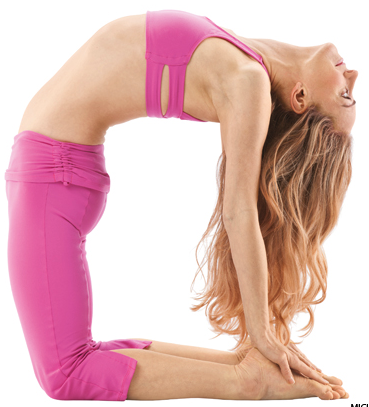
The Camel Pose is an
invigorating backbend, heart opener, and throat opener.It invites a deep extension of the entire
spine and expansion in the chest. On an energetic level, this pose opens the
heart chakra (anahata), and the throat chakra (vishuddha). If you are feeling fearful and guarded
in your heart center, or holding back from your full self-expression, try this
posture to open up those energetic and psychological blocks. What we invite
into our bodies has a transformative effect on our brain chemistry.
Please note that the full-on
version of Ustrasana, with the head
dropping back toward the feet, may not be appropriate for you if you have any
neck pain or injuries of the cervical spine, or if you experience dizziness. Read
on to learn how you can modify to accommodate sensitivity in the neck. First
and foremost, listen to your body!
Prepare for the pose by
warming up the spine with increasingly deeper backbends. Start with Cat/Cow,
cobra, bridge, and bow pose. If
those feel comfortable, you can then proceed to camel.
Cat/Cow
Cobra
Bridge
Bow
1. From Child or Hero pose, come up onto both knees, placing them
hip width apart. Place the palms of the hands on the sacrum with the fingers
pointed down.
2. Inhale and press the knees down reaching the crown of the head
up to lengthen the spine. Exhale and press the hips forward, squeezing the
buttocks and thighs and supporting your weight with the arms as you bend
backwards. Point elbows back behind you.
3. Very carefully reach one hand down to the heel at a time, if you
cannot reach the heels keep the hands on the sacrum. If it feels safe drop the
head all the way back.
4. Holding tightly on to the heels with each hand, actively press
the hips forward, lifting the chest up towards the ceiling. Keep the hips stacked over the knees, with your thigh bones vertical.
5. Breathe and hold for 3-6 breaths.
6. To release: slowly bring one hand at a time back to the sacrum.
With both hands on the sacrum, slowly inhale up, letting the head and neck be
the last to come vertical.
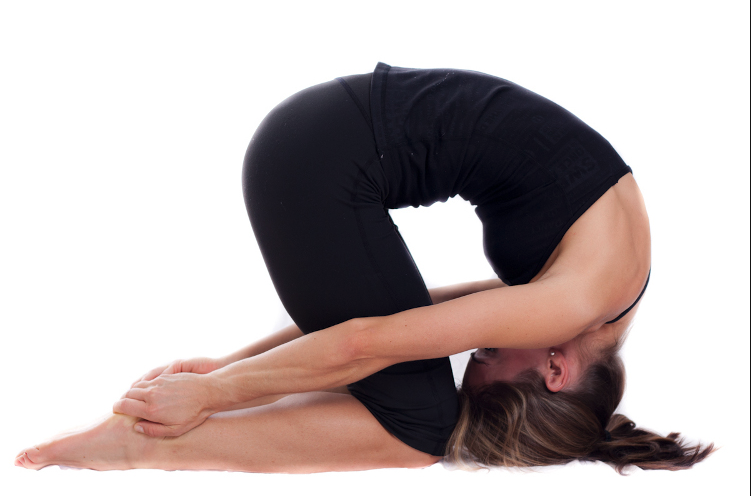
7. After resting for a few
breaths in child’s pose, follow up with the rabbit pose for a delicious counter stretch.
Suggestions for Modifying:
--If your hips tend to fall back toward your heels rather than staying stacked over your knees, try practicing with the front of the pelvis pressed into a wall:
--If allowing the head to drop back
is not appropriate for you, try folding a blanket like a long scarf and
wrapping it around the neck. It should fit snugly, crossing at the heart:
--Or, refrain completely from letting the neck bend backwards:
--If your heels are too far to
reach, try flexing the feet and tucking the toes to lift your heels:
--Or, place blocks beside the
ankles to support you:
--It is
also fine to stay with the hands on the sacrum, simply focusing on lifting the
spine and gently opening the front of the body. This preparatory pose is quite
beneficial in an of itself!
Contraindications: Hernia, or recent abdominal surgery. Recent or chronic knee,
shoulder, neck or back injury or inflammation.
Benefits: Camel Posestretches the entire front of the body, the ankles, thighs and
groins, opens the chest and throat, stretches the deep hip flexors (psoas), tonifies the kidneys and stimulates the respiratory,
circulatory, nervous and endocrine systems. Camel pose makes you feel good all
over!
On an energetic and spiritual
level, the practice of Camel pose cultivates the ability to give and receive
love, and to live our lives in full expression of our creativity and inner truth.
May we be fearless and authentic
in our loving and our expression of that love.
As we once again move around the wheel of the year, we are enjoying the lengthening days which will culminate on the Summer Solstice, June 20th. The practice of Surya Namaskar, or
Salutation to the Sun, offers us a way to honor the sun's journey, to
reflect on the many gifts that we receive from the sun, and to welcome its
return to fullness. It is a meditation-in-motion that draws upon the
qualities of our own divine light, connecting with the radiance of our true
Self. This is a practice which is both contemplative and physical, toning
and strengthening our muscles, nourishing our internal organs, awakening
the energy body with prana, and cultivating a sense of devotion and gratitude.
Our practice begins by tuning in to
the breath. Just as the sun moves from emptiness to fullness as it circles from
Solstice to Solstice, and rises and sets from day into night, so moves our
breath--filling, emptying, filling again in this continual, life-sustaining rhythm.
If we add a short retention at the top of the inhale and at the bottom of the
exhale, we mirror the pause of the sun at the Winter and Summer Solstices (the
word "solstice" comes from the Latin sol, meaning
"sun," and stitium, which means "to pause or stop."
The sun appears to linger for a while at the peak of long, light-filled days in
Summer, or in the very short, dark days of Winter, before we can perceive a
slow shift in the length of the days). So as we turn our attention to our
breath, inviting in a pause in fullness and in emptiness, we still the
mind and calm the nervous system, while honoring the rhythm of life.
While taking a few minutes to breathe
deeply, try bringing the hands into Surya Mudra
(the mudra of the sun), which increases the fire (Agni) element in the body.
This mudra creates warmth, preparing us mentally, physically and energetically
for Surya Namaskar.
The twelve sun mantras
Every year the sun passes
through twelve different phases, known in Western astrology as the
Zodiac,, and 'rashis' in Hindu astrology. Each rashi has a specific attribute
or mood, and in each of these twelve moods the sun is given a different name.
These twelve names comprise the twelve Vedic sun mantras, which are to be
mentally repeated in their respective order in conjunction with the twelve
movements of surya namaskara.
These sun mantras are not
merely names of the sun, but every sound syllable contained in them is the
vehicle of a basic, eternal energy (shakti) represented by the sun itself. By
repetition and concentration on these mantras, one's entire mental and subtle
body will be energized.
Although these mantras do
not require intellectual understanding, translation of their meaning is given
below for those who wish to use the mantras as a form of attunement with the
source of spiritual illumination symbolized by the sun.
Here is the sequence of twelve
postures of Surya Namaskar, with the associated mantras:
1. Om Mitraya Namaha
(Salutations to the
friend of all)
Pranamasana: standing with palms joined at the heart center
This first position
embodies the attitude of reverence to the source of all life as we know it. The
sun is regarded as the universal friend, endlessly giving light, heat and
energy to support this and all the other planets. In the scriptures, Mitra is described as
calling us to activity, sustaining earth and sky, and beholding all creatures
without discrimination, just as the early morning sun signals the beginning of
the day's activities, and sheds its light on all life.
2. Om Ravaye Namaha
(Salutations to the
shining one)
Hasta Uttanasana: hands raised to the sky, slightly bending backwards (if
comfortable)
Ravaye means one who
shines and offers divine blessings upon all life. In this position, we are
stretching our whole being upwards, towards the source of light, to receive
these blessings.
3. Om Suryqya Namaha
Uttanasana: Standing forward bend, hands to the floor
(Salutations to the one who induces
activity)
Here the sun is in a very
dynamic aspect as the deity, Surya. In ancient vedic mythology Surya was
worshipped as the Lord of the Heavens, pictured crossing the sky in his fiery
chariot, drawn by seven horses. The seven horses actually represent the
seven rays or emanations of the supreme consciousness, which manifest as the
seven planes of existence, bhu (earthly, material), bhuvar (intermediate,
astral), suwar (subtle, heavenly), mahar (the abode of the devas), janah (the
abode of divine souls who have transcended ego), tapah (the abode of
enlightened siddhas) and satyam (the ultimate truth of reality). Surya
symbolizes the supreme consciousness itself, in control of all these different
planes of manifestation.
4. Om Bhanave Namaha
(Salutations to the one
who illumines)
Ashwa
Sanchalanasana: Low lunge, back
knee rests on mat. fingertips to the
floor
The sun is the physical
representation of the guru or teacher, who removes the darkness of our
delusions, just as the darkness of the night is removed with every dawn. In
this position, we turn our face towards this illumination and pray for an end
to the dark night of ignorance.
5. Om Khagaya Namaha
(Salutations to the one
who moves through the sky)
Plank pose: shoulders over wrists, arms and legs straight, body in one
line.
It is the sun's daily movement
through the sky which is the basis of our measurement of time, from the
earliest use of a sun dial to the sophisticated devices used today. In this
posture, we offer obeisance to the one by whom time is measured, and pray for
progress in life.
6. Om Pushne Namaha
(Salutations to the giver
of strength and nourishment )
Ashtanga Namaskar: knees, chest, chin, hands and balls of feet touch the floor,
buttocks raised.
The sun is the source of
all strength, nourishing us with energy, light and life. We offer respects in ashtanga
namaskara by touching all the eight corners of our body to the ground. In
essence we are offering our whole being in the hope that the sun may bestow
mental, physical and spiritual strength and nourishment upon us.
7. Om Hiranya Garbhaya Namaha
(Salutations to the
golden cosmic self)
Bujangasana: Cobra pose--palms down, under shoulders, chest and torso raised,
with elbows bent.
Hiranya Garbha is also
known as the golden egg, resplendent as the sun, in which Brahma was born as
the manifestation of Self-existence. Hiranya Garbha is the seed of causality,
thus the whole universe is contained within Hiranya Garbha in the potential
state prior to manifestation. In the same way, all life is potential in the
sun, which represents the great cosmic principle. We offer respects to the sun
in this position, praying for the awakening of creativity.
Maricha is one of
Brahma's sons, just as the rays of light are produced from the sun, but his
name also means mirage. For our whole life, we seek after a true meaning or
purpose, like the thirsty man seeks after water in a desert, but is fooled by
mirages dancing on the horizon produced by the sun's rays. In this position, we pray for true illumination and
discrimination in order to be able to distinguish between the real and the
unreal.
9. Om Adityaya Namaha
(Salutations to the son
of Aditi)
Ashwa Sanchalanasana: Low lunge (whichever leg stepped back now comes forward).
Aditi is one of the many
names given to the cosmic mother, Mahashakti. She is the mother of all the
gods, boundless and inexhaustible, the creative power from which all divisions
of power proceed. The sun is one of her children, or manifestations. In this
position, we salute Aditi, the infinite cosmic mother.
10. Om Savitre Namaha
(Salutations to the
stimulating power of the sun)
Uttanasana: Standing forward bend, hands to the floor
Savitre is known as the stimulator,
the arouser, and is often associated with Surya. Savitre is said to
represent the sun before rising, stimulating and arousing us into waking
activity, and Surya is said to represent the sun after sunrise, when activity
begins. Therefore, in this position, we salute Savitre to obtain the vivifying
power of the sun.
11. Om Arkaya Namaha
(Salutations to the one
who is fit to be praised)
Hasta Uttanasana: hands raised to the sky, slightly bending backwards
Arka means energy. The
sun is the source of most of the energy in the world we know. In this position,
we are offering respects to this source of life and energy.
12. Om Bhaskaraya Namaha
(Salutations to the one
who leads to enlightenment)
Pranamasana: standing with palms joined at the heart center
In this final salutation we offer
respects to the sun as a symbol of the great revealer of all transcendental and
spiritual truths. It lights up the pathway leading to our ultimate goal of
liberation. In this position, we pray that this pathway may be revealed to us.
Finally, we can end our practice in Savasana,
noticing the enlivening effects of Surya Namaskar.
Listen and practice along
with this 16 minute recording:
In a Bikram Yoga class, you
will never do it; in a power vinyasa class, you will do it what feels like a
thousand times. It is an integral part of the sun salutation.
You may love it or despise
it, but Adho Mukha Svanasana, or Downward-Facing Dog Pose, has many benefits, including these:
•Elongates and releases tension from your spine
•Stretches your hamstrings, calves, arches, and hands
•Strengthens your arms, shoulders, and back
•Improves digestion: Although downward-facing dog is
not a full bend or fold, the pose does allow for slight abdominal compression
by drawing the navel into the spine. The pose compresses the organs like the
kidneys, liver and the spleen, aiding in digestion.
•Relieves back pain, headaches, insomnia and fatique
•Helps relieve the symptoms of menopause
•Downward-Facing Dog is a mild inversion that calms the nervous system
and helps relieve stress
•According to BKS Iyengar, a mere
minute in this pose will “bring back lost energy for runners after a hard
race.”
•Strengthens Bones: If
you’re new to yoga, even holding downward dog for a few seconds can cause the
muscles in your upper half to tremble. This is good—shaking means the muscles
in the arms and shoulders are being challenged as they support more of your
body weight. Not only do poses like downward dog promote upper body strength; they
also strengthen bone density and help prevent osteoporosis.
•Relieves Back Pain: As you
strengthen the core muscles (muscles in the torso, consisting of the abdominals
and lower and outer back muscles) with downward dog, don’t overlook the
stretching, aligning, and loosening benefits of this pose on your spine,
shoulders, and back. For instance, in downward dog, the shoulders melt
down the back, the upper back fans out, and the spine is properly aligned to
promote flexible and ease tension.
•Strengthens abdominal muscles: Envision
turning downward-facing dog right side up into boat pose.
Just as you would with boat pose, engaging the belly in downward-facing dog
strengthens and abdominal muscles that support the spine.
•improves circulation: Many
tend to forget that downward-facing dog is an inversion! As the hips lift and
the head drops below the heart, the pull of gravity is reversed and fresh blood
flows, aiding in circulation.
Ideally, when the body is
properly aligned, Downward Facing Dog is a resting pose. Have
you ever wondered why your instructor leads you to take and hold downward dog
between yoga sequences? This is because in addition to promoting a good stretch
to the entire body, downward dog also allows you to take pause or inventory
between postures, as a means to mind-body connection.
In a perfect world, here is
what downward dog looks like when the body is properly aligned.
However many bodies cannot
get fully comfortable in Adho Mukha Svanasana, due to tight hamstrings,
injuries of the wrists or shoulders, or even one’s own unique skeletal
structure (some folks will never get their heels to reach the floor due to the
shape of their bones in the ankle!). So, here are some useful modifications
that you may find helpful:
•Ease pressure on your wrists by placing a wedge under your palms or
performing the pose on your elbows.
•Elevate hands on blocks or on the seat of a chair to release and open
your shoulders.
•Bend knees slightly to flatten lower back.
Check out this helpfulslide show on ways to make downward dog feel better!
Finally, here's a helpful instructional video from Yoga Journal's website that takes you through the pose, step by step:
Whether it's in a hot yoga flow or a traditional Surya Namaskar sequence, Adho Mukha Svanasana is a home base of sorts, a place where we pause together in class and center for a few quiet breaths. As they say in some yoga circles "I'll meet you in Downward Dog!"