As a longtime and dedicated practitioner of yoga, I enjoy learning about and honoring the spiritual and cultural roots of this tradition, which includes the rich mythology of India.
This Friday, February 21st is Maha Shivaratri, or Great Night of Shiva, a Hindu
Festival dedicated to Lord Shiva. It is celebrated with all-day fasting and all-night chanting and dancing. Elaborate and beautiful pujas (devotional ceremonies) are performed in which the Shiva lingam, a stone icon, is worshipped, bathed in holy water, honey, butter, milk and sacred leaves, and is adorned with garlands of flowers.
I’ll offer here a very simplified encapsulation of the story (which has many, many versions): The Devas and Asuras (gods and demons) were churning the bottom of the ocean, both parties in search of amrita, the nectar of immortality.
In the process of this churning, a terrible poison was released-- a poison so potent that even just breathing its powerful fumes would destroy every living being on earth.
What to do? They enlist the help of the all-powerful god Shiva, who agrees to drink the poison in order to save humanity. However, Shiva knew he could not swallow the poison—he had to hold in it his throat until sunrise, at which point the substance would be neutralized and lose its potency.
In order to do this, Shiva needed to stay awake all night. He could not fall asleep, because he might inadvertently swallow the poison. So, the gods and goddesses danced and sang all through the night to keep Shiva awake. By morning, the poison was transformed, but in the process, it turned Shiva’s throat a bluish color. Hence, another name for Shiva is Neelkanth, the blue-throated one.
While I don’t receive these stories as literal truth, I do enjoy mining for the jewels of wisdom that are glistening within them. So, here is the teaching that speaks to me:
As we churn the ocean of our own being, our own minds, in search of what is immortal and eternal (the Self, or True Nature), we can discover some nasty gunk, in ourselves and in the collective ocean of human consciousness. We find the poisons of greed, fear, possessiveness and attachment. We find the toxins of ignorance of our true
nature. We find egoic self-centeredness. In yoga, these common human afflictions
are called kleshas.
The kleshas are qualities of the ego, and we all grapple with them to some degree. They’re just a part of our humanity, and they show us where our work is on our spiritual path.
On this Maha Shivaratri, and also each and every day, may we call upon the transformative power of Shiva to help us stay awake and alert enough to purify our being (from the poisons of the kleshas) and touch into the eternal and immortal Self—that which is not bound by time and space.
There’s a beautiful mantra that asks Shiva to help us to remember who we are beyond the body, and beyond the identities held by our minds:
OM tryambakam yajamahe
sugandhim pusti vardhanam
Urvarukamiva bandhanan
mrtyor mukshiya mamritat
OM. We worship and adore you, O three-eyed one, O Shiva. You are sweet gladness, the fragrance of life, who nourishes all beings. As, in due time, the cucumber ripens and is freed from the vine, may we be freed from attachment and fear of death, and realize the nectar of immortality.
There is a beautiful photo of Shiva sitting in meditation, with his left hand in Jnana Mudra (the mudra of wisdom) and his right hand in Abhaya Mudra (which dispels fear). These two mudras remind us that cultivating the wisdom of the true Self is the great antidote to fear. When we really know who we are as infinite and eternal, we do not fear the death of the body, nor do we fear the dissolution of who we believe ourselves to be.
This night and always, may we drink the sweet nectar of the remembrance of our own divinity.
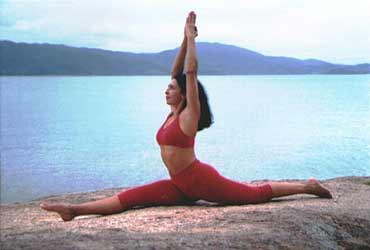
There's a challenging yoga pose where one does a split, with one leg straight forward and the other extending straight behind. Arms are reaching skyward, and the chest and heart are open in a gesture of unwavering YES; it is as if one is leaping forward with trememdous power and courage. This posture is Hanumanasana, the pose of Hanuman, the Hindu monkey god.
In the great Indian epic known as the Ramayana, the story is told of how Hanuman became a devoted servant to Lord Rama. When Rama's wife, Sita, was abducted by an evil king and held captive on the island of Lanka, Hanuman, focusing his will and dedication to serve his Lord, taps into an inner power that allows him to grow to many times his normal size and leap across the ocean in a single bound. With his tail lit on fire, he destroys the demon's kingdom by setting it ablaze, and in the end Sita is rescued and returned to her husband.
In that giant leap Hanuman embodied his love for Rama. His intense devotion allowed him to do the impossible, and this is the lesson of Hanuman: Power comes from devotion.
That mighty leap is memorialized in the pose Hanumanasana. This pose asks you not merely to stretch your legs but also to bring true devotion into your practice.
You could interpret the story of Hanuman, then, as a parable of what happens when you recognize the divine nature of life, offer yourself in service to it, and allow it to transform you in ways you never thought possible, so that you are even more capable of serving your highest ideals. And when you approach the pose with such inspiration, you’re likely to enjoy your journey, no matter how “far” you go in the pose.
Hanuman Jayanti is the Hindu festival honoring the birthday of Hanuman. It is celebrated in the spring,
on the full moon of the Vedic month of Chaitra. So perhaps, during this full moon, you'll be inspired to try the pose (or a more accessible, modified version, such as Ardha Hanumanasana) in your practice this month!
Ardha Hanumanasana
After you are very comfortable with Arda Hanumanasana (Ardha means half), and only if your body is open to going further, you can try entering into the full split. Use blocks aligned under each shoulder, so you are fully supported. This is a very intense stretch for the hamstrings!
If your sit bones don't release all the way to the floor, make sure you place a block, bolster, or rolled blanket underneath you.
That will give you the support you need to lift your torso upright and extend your arms to the sky.
When I was in India in January of 2015, I visited the place where Hanuman was believed to have been born. This spot, now a temple, sits high upon a mountaintop, only accessible by a half-hour climb up winding steps. The words to the Led Zeppelin song "Stairway to Heaven" ran through my head as I panted my way up to the proverbial mountain peak, my skin glistening with sweat in the hot sun. Little brown monkeys flitted about, and I imagined Hanuman's army of helpers (kind of like Santa's elves) making the temple ready for my arrival.
Entering the temple, I was met by a Pujari (priest) who pressed his thumb into my forehead, leaving a red smudge of ceremonial kum kum paste. Extending my right hand, I was given a few drops of holy water to sprinkle on my head, and finally given two little sugar candies as prasad (sweets that have been blessed).
Suspending my rational mind, which entertains all the questions of whether there could really have been a part-monkey-part-human being, how anybody knows when or where he was born, etc,, I simply allowed my heart to open to the qualities that Hanuman embodies--courage, strength, playfulness, and unwavering devotion to God. These are the qualities that I can embrace, no matter whether or not he was actually "real." I've heard it said that truth is greater than fact. The Truth is that we all have the ability to be like Hanuman, focusing our lives on loving service to the Beloved, and drawing upon our inner strength and taking a leap of faith to do what we know is right.
Hanuman's Birthplace Temple
Chanting the Hanuman Chaleesa, a hymn honoring the monkey god
As we approach the Winter Solstice, we in the Northern Hemisphere are experiencing a time of increasing darkness. On December 21st, the Longest Night, the diminishing daylight reaches its peak, and the sun begins its gradual ascent back to the balance of Spring Equinox, returning to fullness on the Longest Day, Summer Solstice.
The practice of Surya Namaskar, or Salutation to the Sun, offers us a way to honor the sun's journey, to reflect on the many gifts that we receive from the sun, and to welcome its return to fullness. It is a meditation-in-motion that draws upon the qualities of our own divine light, connecting with the radiance of our true Self. This is a practice which is both contemplative and physical, toning and strengthening our muscles, nourishing our internal organs, awakening the energy body with prana, and cultivating a sense of devotion and gratitude.
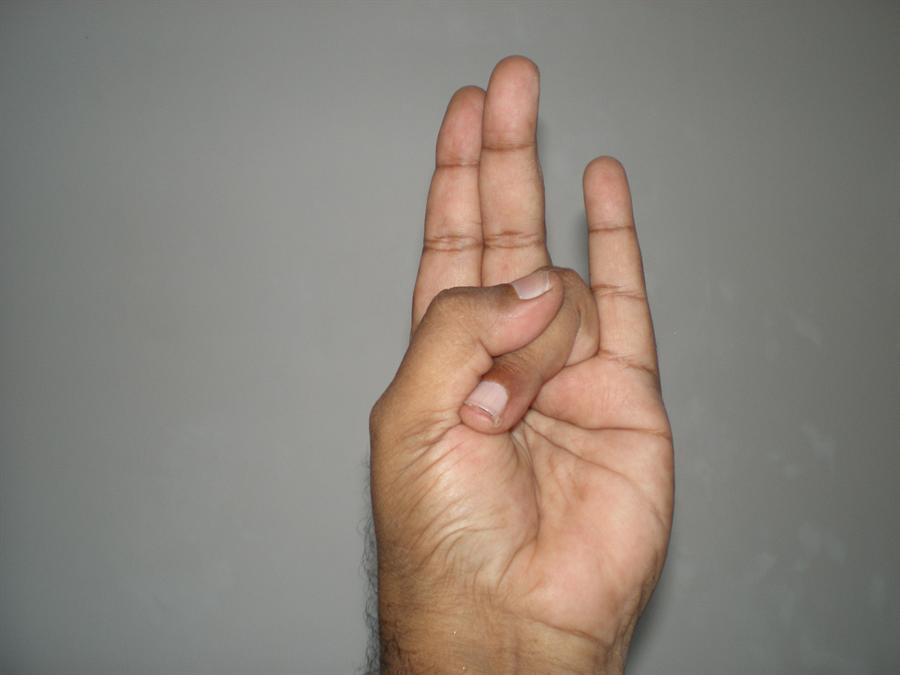
Our practice begins by tuning in to the breath. Just as the sun moves from emptiness to fullness as it circles from Solstice to Solstice, and rises and sets from day into night, so moves our breath--filling, emptying, filling again in this continual, life-sustaining rhythm. If we add a short retention at the top of the inhale and at the bottom of the exhale, we mirror the pause of the sun at the Winter and Summer Solstices (the word "solstice" comes from the Latin sol, meaning "sun," and stitium, which means "to pause or stop." The sun appears to linger for a while at the peak of long, light-filled days in Summer, or in the very short, dark days of Winter, before we can perceive a slow shift in the length of the days). So as we turn our attention to our breath, inviting in a pause in fullness and in emptiness, we still the mind and calm the nervous system, while honoring the rhythm of life. While taking a few minutes to breathe deeply, try bringing the hands into Surya Mudra (the mudra of the sun), which increases the fire (Agni) element in the body. This mudra creates warmth, preparing us mentally, physically and energetically for Surya Namaskar.
The
twelve sun mantras
Every
year the sun passes through twelve different phases, known in Western astrology as the Zodiac,, and 'rashis' in Hindu astrology. Each rashi has a specific attribute or mood, and in each of these
twelve moods the sun is given a different name. These twelve names comprise the
twelve Vedic sun mantras, which are to be mentally repeated in their respective order
in conjunction with the twelve movements of surya namaskara.
These
sun mantras are not merely names of the sun, but every sound syllable contained
in them is the vehicle of a basic, eternal energy (shakti) represented by the
sun itself. By repetition and concentration on these mantras, one's entire mental and subtle body will be energized.
Although
these mantras do not require intellectual understanding, translation of their
meaning is given below for those who wish to use the mantras as
a form of attunement with the source of spiritual illumination symbolized by
the sun.
Here is the sequence of twelve postures of Surya Namaskar, with the associated mantras:
1.
Om Mitraya Namaha
(Salutations
to the friend of all) Pranamasana: standing with palms joined at the heart center This first position embodies the attitude of reverence to the source
of all life as we know it. The sun is regarded as the universal friend,
endlessly giving light, heat and energy to support this and all the other
planets. In the scriptures, Mitra is described as
calling us to activity, sustaining earth and sky, and beholding all creatures
without discrimination, just as the early morning sun signals the beginning of
the day's activities, and sheds its light on all life.
2.
Om Ravaye Namaha
(Salutations
to the shining one) Hasta Uttanasana: hands raised to the sky, slightly bending backwards (if comfortable)
Ravaye
means one who shines and offers divine blessings upon all life. In this position, we are stretching our whole being upwards, towards
the source of light, to receive these blessings.
3.
Om Suryqya Namaha Uttanasana: Standing forward bend, hands to the floor
(Salutations
to the one who induces activity)
Here
the sun is in a very dynamic aspect as the deity, Surya. In ancient vedic
mythology Surya was worshipped as the Lord of the Heavens, pictured crossing
the sky in his fiery chariot, drawn by seven horses. The seven horses actually represent
the seven rays or emanations of the supreme consciousness, which manifest as
the seven planes of existence, bhu (earthly, material), bhuvar (intermediate,
astral), suwar (subtle, heavenly), mahar (the abode of the devas), janah (the
abode of divine souls who have transcended ego), tapah (the abode of
enlightened siddhas) and satyam (the ultimate truth of reality). Surya
symbolizes the supreme consciousness itself, in control of all these different
planes of manifestation.
4.
Om Bhanave Namaha
(Salutations
to the one who illumines) Ashwa Sanchalanasana: Low lunge, back knee rests on mat. fingertips to the floor
The
sun is the physical representation of the guru or teacher, who removes the
darkness of our delusions, just as the darkness of the night is removed with
every dawn. In this position, we turn our face
towards this illumination and pray for an end to the dark night of ignorance.
5.
Om Khagaya Namaha
(Salutations
to the one who moves through the sky) Plank pose: shoulders over wrists, arms and legs straight, body in one line.
It
is the sun's daily movement through the sky which is the basis of our
measurement of time, from the earliest use of a sun dial to the sophisticated
devices used today. In this posture, we offer obeisance to the one by whom time
is measured, and pray for progress in life.
6.
Om Pushne Namaha
(Salutations
to the giver of strength and nourishment ) Ashtanga Namaskar: knees, chest, chin, hands and balls of feet touch the floor, buttocks raised.
The
sun is the source of all strength, nourishing us with energy,
light and life. We offer respects in ashtanga namaskara by touching all the
eight corners of our body to the ground. In essence we are offering our whole
being in the hope that the sun may bestow mental, physical and spiritual strength
and nourishment upon us.
7.
Om Hiranya Garbhaya Namaha
(Salutations
to the golden cosmic self) Bujangasana: Cobra pose--palms down, under shoulders, chest and torso raised, with elbows bent.
Hiranya
Garbha is also known as the golden egg, resplendent as the sun, in which Brahma
was born as the manifestation of Self-existence. Hiranya Garbha is the seed of
causality, thus the whole universe is contained within Hiranya Garbha in the
potential state prior to manifestation. In the same way, all life is potential
in the sun, which represents the great cosmic principle. We offer respects to
the sun in this position, praying for the awakening of
creativity.
8.
Om Marichaye Namaha
(Salutations
to the rays of the sun) Adho Mukha Svanasana: Downward-facing dog. Inverted V, hips high, hands and feet flat.
Maricha
is one of Brahma's sons, just as the rays of light are produced from the sun,
but his name also means mirage. For our whole life, we seek after a true
meaning or purpose, like the thirsty man seeks after water in a desert, but is
fooled by mirages dancing on the horizon produced by the sun's rays. In
this position, we pray for true illumination and
discrimination in order to be able to distinguish between the real and the
unreal.
9.
Om Adityaya Namaha
(Salutations
to the son of Aditi) Ashwa Sanchalanasana: Low lunge (whichever leg stepped back now comes forward).
Aditi
is one of the many names given to the cosmic mother, Mahashakti. She is the
mother of all the gods, boundless and inexhaustible, the creative power from
which all divisions of power proceed. The sun is one of her children, or
manifestations. In this position, we salute Aditi,
the infinite cosmic mother.
10.
Om Savitre Namaha
(Salutations
to the stimulating power of the sun) Uttanasana: Standing forward bend, hands to the floor
Savitre
is known as the stimulator, the arouser, and is often associated with Surya. Savitre is said to represent
the sun before rising, stimulating and arousing us into waking activity, and
Surya is said to represent the sun after sunrise, when activity begins.
Therefore, in this position, we salute Savitre to obtain the
vivifying power of the sun.
11.
Om Arkaya Namaha
(Salutations
to the one who is fit to be praised) Hasta Uttanasana: hands raised to the sky, slightly bending backwards
Arka
means energy. The sun is the source of most of the energy in the world we know.
In this position, we are offering respects to this
source of life and energy.
12.
Om Bhaskaraya Namaha
(Salutations
to the one who leads to enlightenment) Pranamasana: standing with palms joined at the heart center
In
this final salutation we offer respects to the sun as a symbol of the great
revealer of all transcendental and spiritual truths. It lights up the pathway
leading to our ultimate goal of liberation. In this position, we pray that this pathway may be revealed to us.
Finally, we can end our practice in Savasana, noticing the enlivening effects of Surya Namaskar.
Note: The above interpretation of the sun mantras is referenced from the book “Surya Namaskara” from the Bihar School of Yoga. Listen and practice along with this 16 minute recording:
There's
a challenging yoga pose where one does a split, with one leg straight
forward and the other extending straight behind. Arms are reaching
skyward, and the chest and heart are open in a gesture of unwavering
YES; it is as if one is leaping forward with trememdous power and
courage. This posture is Hanumanasana, the pose of Hanuman, the Hindu monkey god.
Tuesday, April 15th is Hanuman Jayanti,
the Hindu festival honoring the birthday of Hanuman. So, I thought I'd
share with you a little bit about this beloved character, and perhaps
you'll be inspired to try the pose (or a more accessible, modified
version, such as ardha Hanumanasana) in your practice this month!
Hanuman is worshiped as a symbol of physical strength, perseverance and devotion. In the epic tale known as the Ramayana,
Hanuman is the servant of Lord Rama, and he demonstrates his unwavering
and complete devotion to his Master with amazing feats of courage and
strength. At one point in the story, Rama’s beloved wife Sita is
abducted by the demon king Ravana, and she is held captive on the island
of Lanka. Hanuman is given the task of crossing the ocean to find Sita.
By the power of unwavering intention and loving service, he makes
himself grow to a colossal size, and fixing his thoughts on the Divine
Goddess Sita, he leaps across the ocean in a single bound. Lighting his
tail on fire, he takes to the streets of Lanka and burns down the palace
where Sita’s captor dwells.
After Rama and Sita are reunited,
Hanuman is given a string of pearls as a token of appreciation. He
immediately breaks the necklace and begins cracking each pearl open with
his teeth. When asked why he is doing this, Hanuman replies that he
wants to see if Rama's name is present in the pearls. If it isn’t, then
the necklace has no value to him. Sita then asks Hanuman if Rama is
inside of him as well. At this point, the monkey god rips open his chest
to reveal the name of Rama inscribed on every organ, muscle and bone,
and the images of Sita and Rama are found on his heart.
The story of Hanuman’s strength and devotion are also depicted in the Hanuman Chalisa,
a forty verse hymn written by 16th century Hindu saint and poet Tulsi
Das. Many find great inspiration in singing these verses. In fact, there
are many versions with different melodies by the kirtan artist Krishna
Das. On his CD and book set Flow of Grace, Krishna Das sings
the chalisa and provides instruction, interpretation and proper Hindi
pronunciation for those who wish to learn to sing this beautiful hymn.
The
Hanuman Chalisa is chanted specifically to clean the mirror of our
hearts so we can come into direct contact with the grace of Hanuman. His
river of grace flows into our nearly dried-up stream and fills it with
the water of life, awakening us to the awareness of Ram's (God's)
presence within. This is when our hearts truly come alive. Once the
waters of two rivers mingle, they can never be separated. ~Krishna Das, in Flow of Grace
Hanuman inspires us to find strength
within ourselves we might never have known we had. He is an example of
discovering our forgotten potency. It wasn’t until he took that giant
leap across the ocean that he became aware of his own strength. It was
something he had never done before--it was a “leap of faith.” But
because his whole heart and mind were directed toward loving and serving
God, this hidden potency emerged and empowered him. It is said that the
word impossible is not a word in a devotee’s dictionary.
So, I invite you to reflect on an area
of your life where you can offer your unwavering service and devotion.
What calls you forth to summon your inner strength and courage? Can you
take that leap of faith?
At this time of year, when the growing season comes to a close and the earth prepares for dormancy, I am reminded of Shiva, the Hindu deity that embodies transformation and change. In the Hindu Trinity that consists of Brahma (the creative force that brings all forms into being), and Vishnu (the preserver, who sustains and balances all life), Shiva is the destroyer, and is responsible for the necessary dissolution of all life forms, creating space for new birth.
Shiva is the power of transformation and purification that lives in each of us. Shiva clears away whatever is old and no longer serves us. Shiva calls us to let go of illusion, to dissolve the egoic mind that keeps us stuck in our sense of separateness, and lovingly destroys all that keeps us from knowing our inherent divinity.
And, Shiva is also that state of Grace, that pure consciousness that is present when all illusion falls away. So, Shiva is both a process of transformation and the end result of that process.
Iconically, Shiva is represented in myriad ways. One common image is the Nataraj, or dancer, who dances wildly in a ring of fire, turning everything to dust. This fire dance symbolizes the circle of samasara, the earthly round of creation and destruction through which all beings pass.
In addition to being the destroyer, Shiva is often depicted as a contemplative, who after witnessing the suffering of earthly beings, sought to find a way to peace and freedom. This search led him into deep meditation, leading to the discovery of the yoga asanas and other practices, which he then taught to his wife, Parvati.
Shiva is also worshipped in the form of the lingam, a stone phallus. Elaborate pujas (devotional rituals) are performed in which the lingam is bathed in milk and honey, decorated with garlands of flowers, and smeared with fragrant sandalwood paste. The Shiva lingam represents the vast potential and possibility that lies within each and every one of us. So, although Shiva is responsible for destroying life, He is also recognized as an essential creative power.
One can explore in great depth the myth and symbolism behind any of the gods and goddesses in the Hindu pantheon. For some, the anthropomorphic images and stories can help them connect to the energy that lies behind the forms. However, it is not necessary for one to believe in a literal deity in order to access their power. We only need to look at life around us to receive their essence.
Autumn is a time when we can feel and see the presence of Shiva, as we witness the falling away of what is finished. In every leaf that falls, Shiva is present. In every withering vine, Shiva is alive.
Shiva is present when we say goodbye to loved ones who have come to the end of their life in this body and must pass on.
Whenever we must let go of an old habit or some way of being that no longer serves us, Shiva is alive in us, doing his dance of transformation, clearing us out and creating an opening for the new to come streaming in.
And, Shiva lives in us as we practice yoga and meditation, as we seek to unleash our own innate transformative power, through this path to peace.
I offer you this chant that I often sing as an invocation to begin our yoga classes:
Om Namah Shivaya Gurave
Saccidananda Murtaye
Nischprapanchaya Shantaya
Niralambaya Tejase
I bow to the goodness within myself, known as Lord Shiva, who is the true teacher.
This essence inside takes the form of truth, consciousness, and bliss
Always present and full of peace,
this essence inside is completely free,
and sparkles with a divine luster.
May our yoga practice illuminate the divine luster within us, and together may we bring light to the world.
This Monday, April 18th, my husband, Doug, will be running in the Boston Marathon. It's his first marathon ever, and he has been training for six months for this event. It will perhaps take the most strength and focused will that he's ever had to summon. I think it's auspicious that Doug is running on Monday, because it also happens to be Hanuman Jayanti, the Hindu festival honoring the birthday of Hanuman, the monkey god.
Hanuman is worshiped as a symbol of physical strength, perseverance and devotion. In the epic tale known as the Ramayana, Hanuman is the servant of Lord Rama, and he demonstrates his unwavering and complete devotion to his Master with amazing feats of courage and strength. At one point in the story, Rama’s beloved wife Sita is abducted by the demon king Ravana, and she is held captive on the island of Lanka. Hanuman is given the task of crossing the ocean to find Sita. By the power of unwavering intention and loving service, he makes himself grow to a colossal size, and fixing his thoughts on the Divine Goddess Sita, he leaps across the ocean in a single bound. Lighting his tail on fire, he takes to the streets of Lanka and burns down the palace where Sita’s captor dwells.
After Rama and Sita are reunited, Hanuman is given a string of pearls as a token of appreciation. He immediately breaks the necklace and begins cracking each pearl open with his teeth. When asked why he is doing this, Hanuman replies that he wants to see if Rama's name is present in the pearls. If it isn’t, then the necklace has no value to him. Sita then asks Hanuman if Rama is inside of him as well. At this point, the monkey god rips open his chest to reveal the name of Rama inscribed on every organ, muscle and bone, and the images of Sita and Rama are found on his heart.
The story of Hanuman’s strength and devotion are also depicted in the Hanuman Chalisa, a forty verse hymn written by 16th century Hindu saint and poet Tulsi Das. Many find great inspiration in singing these verses. In fact, there are many versions with different melodies by the kirtan artist Krishna Das. On his CD and book set Flow of Grace, Krishna Das sings the chalisa and provides instruction, interpretation and proper Hindi pronunciation for those who wish to learn to sing this beautiful hymn.
The Hanuman Chalisa is chanted specifically to clean the mirror of our hearts so we can come into direct contact with the grace of Hanuman. His river of grace flows into our nearly dried-up stream and fills it with the water of life, awakening us to the awareness of Ram's (God's) presence within. This is when our hearts truly come alive. Once the waters of two rivers mingle, they can never be separated.~Krishna Das, in Flow of Grace
Hanuman inspires us to find strength within ourselves we might never have known we had. He is an example of discovering our forgotten potency. It wasn’t until he took that giant leap across the ocean that he became aware of his own strength. It was something he had never done before--it was a “leap of faith.” But because his whole heart and mind were directed toward loving and serving God, this hidden potency emerged and empowered him. It is said that the word impossible is not a word in a devotee’s dictionary.
So, I invite you to reflect on an area of your life where you can offer your unwavering service and devotion. What calls you forth to summon your inner strength and courage? Can you take that leap of faith?
This month brings the Hindu festival known as Maha Shivaratri, or "great night of Shiva" (also called simply Shivaratri). This celebration falls on the eve of the new moon in February-March, and is a night set aside for worship and remembrance of Shiva.
The legend says that the gods (devas) and demons were churning the ocean of consciousness in search of the Divine nectar of immortality. However, after a great deal of effort, what emerged was not nectar, but poison. The devas and demons knew that in order to continue churning, and ultimately to unearth the Divine nectar, they could not simply toss the poison aside-- someone had to drink it. Lord Shiva volunteered to swallow the poison for the sake of humanity. As a result, his throat turned blue, although Shiva was not harmed. The divine doctors advised Shiva to stay awake for a full night to allow his body to be fully cleansed of the toxin. The gods and goddesses responded with energetic dances and ecstatic chanting to keep him awake until sunrise.
Each year, in commemoration of this event, Hindus stay awake all night chanting repetitions of the mantra "OM Namah Shivaya." According to tradition, the planetary positions on this night are such that there is a powerful natural upsurge of energy in the human system. It is said to be beneficial for one's physical and spiritual wellbeing to stay awake and aware throughout the night, immersed in singing and prayer.
Shivaratri is also a day of fasting. Observances also involve elaborate pujas (worship rituals)and abhishekas (bathing ceremonies) to the Shiva Lingam (a stone phallus representing Shiva) that include offerings of special (Bilva) leaves. The lingam is bathed with water, milk, and honey and decorated with flowers, garlands, and sandalwood paste.
The lingam is symbolic of the Divine Creative manifestation. Its shape is representative of the power of Shiva, the Lord of Creation, the masculine creative energy. The markings symbolize the feminine energy, the seed which is fertilized to manifest the creative power in the dance of the cosmos.
The Shiva lingam represents the vast potential and possibility that lies within each and every one of us. If you do a search on Google Images for "Shiva lingam", you will see a wide variety of representations. The lingam is often placed in a holder that represents the yoni, a female symbol of the Divine feminine.
Maha Shivaratri is considered to be the prime time for every soul to touch into the primordial consciousness of Nirvana. One receives Shiva's grace and assistance by keeping vigil during the night.. Maha Shivaratri signifies the transition from the darkness of gloom and ignorance to the dawn of divine joy and knowledge.
As Western yogis, it may not be practical or possible for us to stay up all night chanting. But we can reflect upon how we can stay awake and aware through all the toxicity of our modern world. We can create our own rituals to affirm our commitment to staying present and fully alive, awake to our spirit amidst the the poison of media, global violence, war, racism, environmental destruction, and poverty. Can we stay awake to our divinity through it all?
Hindu mythology suggests that Lord Shiva is the founder of yoga, the Adi Guru (first teacher). Whether one accepts this in the literal sense or not, it can be powerful to remember that this practice of yoga, which transforms our lives, began somewhere as a spark of Divine inspiration many millenia ago. It has been passed along through the generations from teacher to student, via countless great and wise masters whose names we will never know. I like to think of it as a seed that was planted that has grown into a great and mighty tree that is spreading its branches in all directions as many styles and traditions of yoga continue to evolve. Today we enjoy the fruits of that tree, and Shiva is the original seed from which it sprouted. As we taste the sweet nectar of these fruits and offer it to one another, we are honoring Lord Shiva and embodying that Divine spark.